


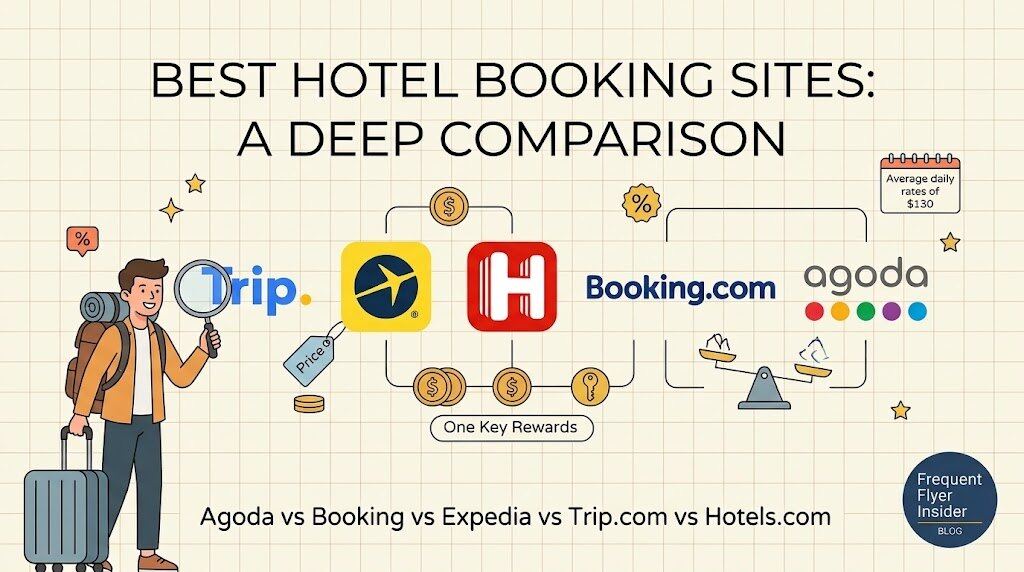
Finding the lowest hotel rate usually means checking multiple booking websites. Platforms like Agoda, Booking.com, Trip.com and Expedia often list the exact same hotel room at different prices. The features, payment methods, and regional strengths of each online travel agency (OTA) dictate where you will find the best deal.
Here is a direct comparison of the major hotel booking websites, how they differ, and how to use them effectively to lower your travel costs.
The Global OTA Landscape
Online hotel booking is a consolidated industry. The globally recognized booking platforms belong to two major corporate groups, which operate alongside the direct booking platforms of multinational hotel chains.
- Booking Holdings: Operates Booking.com, Priceline, Agoda, Kayak, OpenTable, Rentalcars.com, Rocketmiles, FareHarbor, HotelsCombined, Cheapflights, and Momondo.
- Expedia Group: Operates Expedia, Hotels.com, Vrbo, Travelocity, Hotwire.com, Orbitz, Ebookers, CheapTickets, CarRentals.com, Expedia Cruises, Wotif, and Trivago.
- Major Hotel Chains: Includes brands like Marriott, Hilton, IHG, Accor, and Hyatt, which manage their own proprietary booking systems.
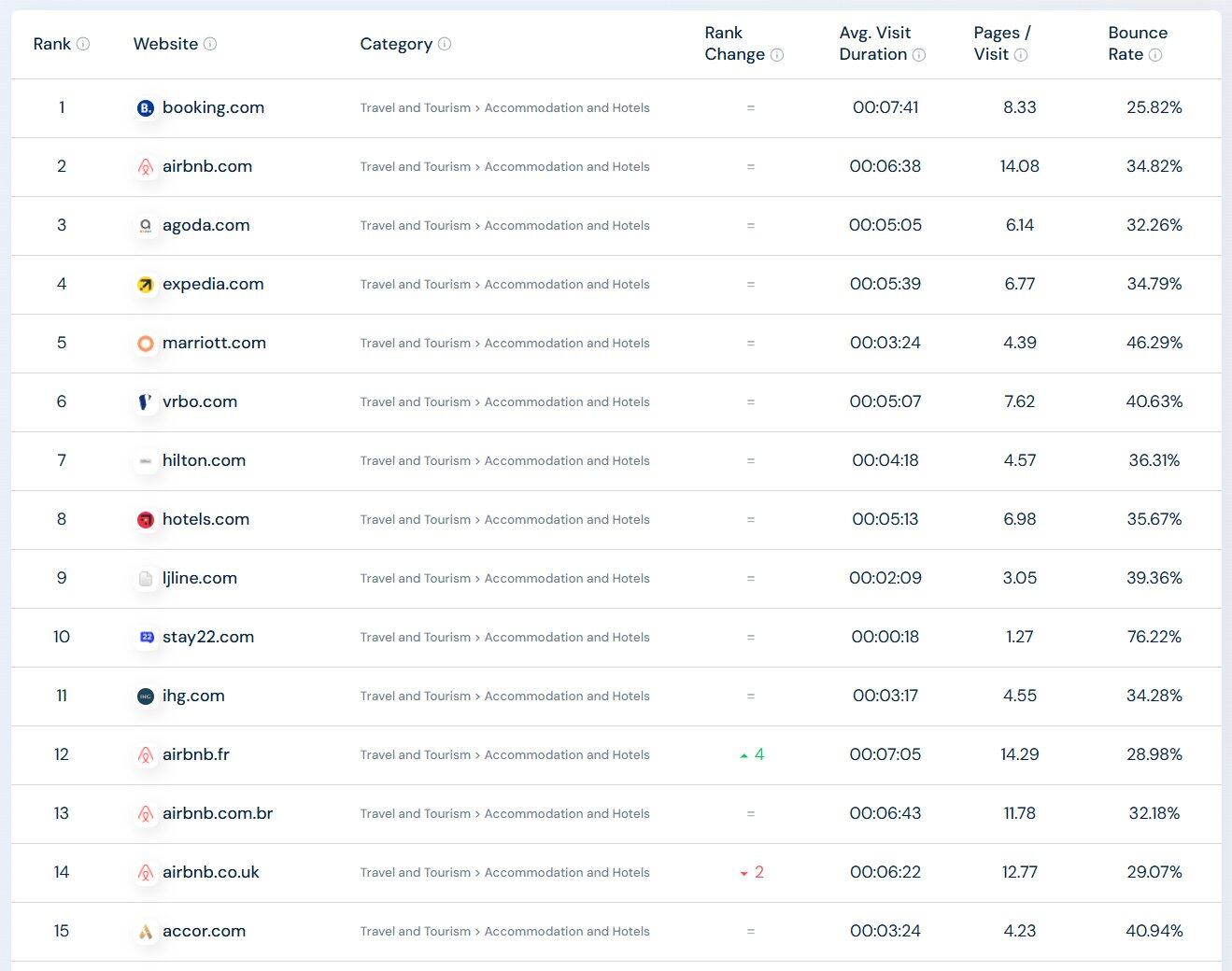
Web traffic data from Similarweb (as of July 2026) indicates that Booking.com, Agoda, Expedia, and Hotels.com maintain the highest traffic volumes among global travel websites.
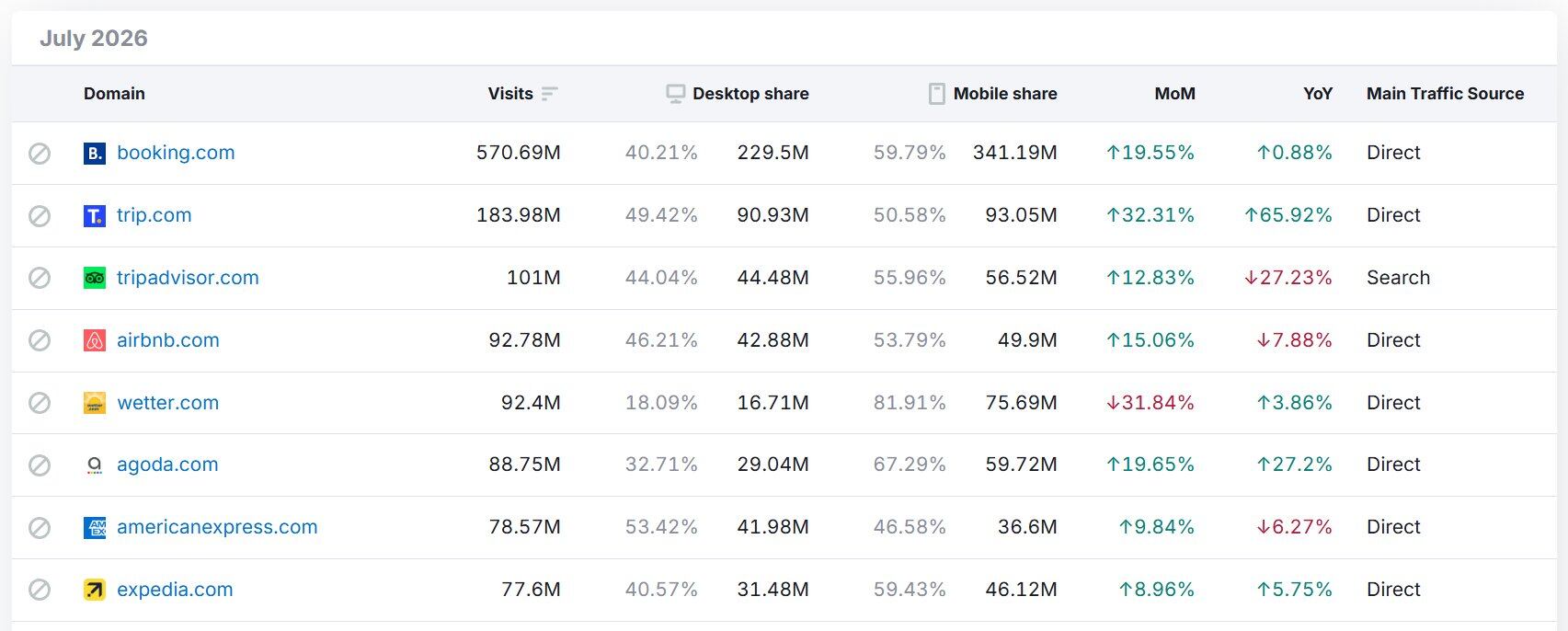
Trip.com does not always appear on standard Western traffic leaderboards. However, Semrush data shows it holds the second-highest visit volume globally, just behind Booking.com. It is part of the Trip.com Group, which also runs the mainland China platform Ctrip.com and the flight comparison site Skyscanner.
Agoda: Best for Asia-Pacific Travel
Agoda is headquartered in Singapore and is owned by Booking Holdings. It is highly popular for travel within the Asia-Pacific region, including countries like Thailand, Japan, and Singapore.
The platform consistently offers lower base rates for Asian destinations compared to its competitors. Agoda also partners directly with many credit card companies. Accessing the site through specific bank promo links can often trigger an automatic discount on your booking.
A major difference between Agoda and other platforms is the payment structure. Agoda primarily uses a “Pay Now” model where you pay the platform directly at the time of booking.
Pros of Agoda:
- Consistently cheaper rates for hotels in the Asia-Pacific region.
- Direct payment to Agoda reduces the risk of credit card fraud at the local hotel level.
- When searching by a city name (not a specific hotel), the date selection calendar displays the average daily rate for the next two months, making it easy to spot cheaper days to travel.
- Supports local payment methods like PayPal, Apple Pay, Alipay, and local e-wallets.
Cons of Agoda:
- Rates in Europe and the Americas are rarely competitive.
- Initial search prices notoriously exclude taxes and service fees. However, there is a handy workaround if you use the Agoda App: navigate to “More” > “Settings” > “Price Display” and toggle it to either “Total stay (Includes taxes and fees)” or “Average per night (Includes taxes and fees).” This reveals the true, all-in price right on the search and room selection pages—but keep in mind, this trick is strictly limited to the mobile app.
- Customer service can be difficult to reach; you need a valid booking ID and the last four digits of your credit card just to speak to an agent.
Agoda’s pricing can be highly sensitive to how you arrive at the site. A rate found by clicking through a comparison site might be slightly different than if you open a new tab and search for the same hotel directly on Agoda. Always test both methods before checking out. Furthermore, avoid using Agoda's “Pay Later” feature, as they apply a 5% currency conversion markup when charging your card at a later date.
AgodaVIP Loyalty Program
Agoda rewards loyal customers through its AgodaVIP program, which grants access to special insider rates and exclusive VIP deals.
| Tier | Requirement | Key Benefits |
|---|---|---|
| VIP Bronze | Automatic entry | Best price guarantee, Insider deals |
| VIP Silver | 2 bookings | VIP deals up to 12% off |
| VIP Gold | 5 bookings or $200 spent | VIP deals up to 18% off |
| VIP Platinum | 10 bookings or $400 spent | VIP deals up to 25% off, free breakfast/perks at select properties |
| VIP Diamond | 15 bookings & $1,500 spent | Priority customer support, special limited-time benefits |
Booking.com: Best for Europe, the Americas, and Filtering Options

Booking.com is the largest hotel reservation platform in the world. Also owned by Booking Holdings, it functions differently than Agoda by focusing heavily on Europe and the Americas.
Booking.com uses an agency model. This means you reserve the room through the website, but you usually pay the hotel directly when you arrive. This setup makes Booking.com ideal for travelers who want flexible cancellation policies or prefer not to tie up their cash months in advance.
Pros of Booking.com:
- Massive inventory globally, especially in Europe and North America.
- Features the most robust and accurate filtering system in the industry, making it easy to find specific amenities, accessibility features, or property types.
- “Pay at Property” is the standard, making cancellations and changes easier.
- The Genius loyalty program applies discounts automatically once you reach different tiers.
Cons of Booking.com:
- While it has a massive inventory, it is no longer consistently the cheapest option for mid-range hotels.
- Tax inclusions vary heavily by region; what you see on the search page might not be the final price.
- Credit card details are often passed directly to the hotel staff to secure the booking.
Because Booking.com shares your credit card information with the property for guarantee purposes, there is a minor security risk when booking small, independent guesthouses in certain regions. Consider using a virtual credit card number or a card with a low credit limit for these specific reservations.
Booking.com Genius Loyalty Program
Booking.com offers a free, lifetime-access loyalty program called Genius. Once you unlock a level, the rewards are yours to keep forever.
| Tier | Requirement | Key Benefits |
|---|---|---|
| Genius Level 1 | Automatic entry | 10% discounts on stays, 10% discounts on select rental cars |
| Genius Level 2 | 5 bookings within 2 years | 10–15% discounts on stays, 10–15% discounts on select rental cars, free breakfasts/room upgrades on select stays |
| Genius Level 3 | 15 bookings within 2 years | 10–20% discounts on stays, priority support on all stays |
Hotels.com: Best for Cross-Platform Flexibility

Hotels.com is part of the Expedia Group. For years, its main draw was a simple “Stay 10 nights, get 1 free” rewards program. However, this has been entirely replaced by the One Key rewards program, which it now shares with Expedia and Vrbo.
Instead of earning free nights, you now earn “OneKeyCash” based on the dollar amount you spend. You earn a flat 2% back in OneKeyCash on eligible hotel stays and car rentals. This cash can then be spent across Hotels.com, Expedia, or Vrbo.
Pros of Hotels.com:
- OneKeyCash is highly flexible. You can earn rewards on a hotel stay and spend them on a vacation rental (Vrbo) or a flight (Expedia) with no blackout dates.
- Logged-in members get immediate access to discounted baseline “Member Prices.”
- You collect “trip elements” (like a single hotel night or a car rental day) to move up tiers (Silver, Gold, Platinum), which can unlock extra perks like room upgrades or higher earning rates at specific “VIP Access” properties.
Cons of Hotels.com:
- The One Key program is a significant devaluation from the old program. The baseline return dropped from roughly 10% value to just 2%.
- Prices shown in the initial search do not include taxes and fees.
- The base prices are rarely the cheapest unless you apply a promo code or use your accumulated OneKeyCash.
Because Hotels.com and Expedia now use the exact same backend and the identical One Key rewards program, there is very little functional difference between the two when booking standalone hotels. Simply use whichever site has a better interface for your needs, or whichever app happens to offer a “Mobile Exclusive” discount that day.
Hotels.com One Key Rewards Program
Hotels.com uses the One Key program, where you collect “Trip Elements” (e.g., 1 hotel night or 1 car rental day equals 1 element) over a calendar year to move up tiers.
| Tier | Requirement | Key Benefits |
|---|---|---|
| Blue | 0-4 trip elements | 10%+ off on stays, 2% OneKeyCash earn rate, ‘Save Your Way‘ flexible rewards |
| Silver | 5-14 trip elements | 15%+ off on stays, 3% OneKeyCash and perks (e.g., free breakfast) at VIP Access stays, priority support |
| Gold | 15-29 trip elements | 20%+ off on stays, 4% OneKeyCash and room upgrades at VIP Access stays |
| Platinum | 30+ trip elements | 20%+ off on stays, 6% OneKeyCash at VIP Access stays, platinum VIP support |
Expedia: Best for Bundling Flights and Hotels

Expedia is a massive comprehensive booking site. While it operates similarly to Hotels.com for standalone room reservations, its true value lies in package deals.
If you need to book a flight and a hotel for the same trip, Expedia's system applies significant discounts when you bundle them together in a single transaction. Expedia also displays the full price with taxes and fees upfront on its initial search results page, a rare and highly useful feature.
Pros of Expedia:
- Excellent discounts when booking a “Flight + Hotel” package.
- Initial search results clearly show the total price including taxes, resort fees, and property fees.
- Shares the One Key rewards program with Hotels.com and Vrbo, allowing you to pool rewards across different types of travel.
Cons of Expedia:
- Booking a hotel on its own is rarely cheaper than checking Agoda or Booking.com.
- The location filters (like searching by neighborhood) are notoriously inaccurate.
- Earning OneKeyCash on flights is very low (only 0.2% back).
If you are booking a standalone hotel on Expedia, check the price on mobile. Expedia frequently offers “Mobile Exclusive” discounts of up to 10% if you complete the booking through their smartphone app instead of a desktop browser.
Expedia One Key Rewards Program
Expedia shares the exact same One Key rewards program as Hotels.com. Progress is tracked via “Trip Elements” (flights, hotel nights, car rental days, etc.) across a calendar year.
| Tier | Requirement | Key Benefits |
|---|---|---|
| Blue | 0-4 trip elements | 10%+ off on stays and car rentals, 2% OneKeyCash, free price tracking for flights |
| Silver | 5-14 trip elements | 15%+ off on stays, 3% OneKeyCash and perk (e.g., free breakfast) at VIP Access, priority support |
| Gold | 15-29 trip elements | 20%+ off on stays, 4% OneKeyCash and room upgrades at VIP Access, Price Drop Protection (flights) |
| Platinum | 30+ trip elements | 6% OneKeyCash at VIP Access, platinum VIP support |
Trip.com: Best for Customer Service and Asian Travel

Trip.com is an international booking platform headquartered in Singapore. It supports multiple languages and currencies and has a significant edge in the Asian market due to its extensive hotel network in China and neighboring regions.
A standout feature of Trip.com is its transparency and its customer support. Unlike many Western OTAs, Trip.com provides highly accessible, 24/7 human customer service and clearly displays fees.
Pros of Trip.com:
- Unmatched hotel inventory and pricing for mainland China, Hong Kong, and Macau.
- Initial search results display the true, full price of a stay, including taxes and fees.
- Offers a price match guarantee if you find a lower rate on another website.
- Exceptional 24/7 customer service with easy access to live agents.
- The Trip.com app includes a free VoIP call feature to reach support.
Cons of Trip.com:
- Hotel inventory and pricing in Europe and North America lag behind Booking.com and Expedia.
- Sorting and location filtering options are highly limited and sometimes rely on inaccurate center-of-town metrics.
Download the Trip.com app before you travel abroad. If you encounter an issue at the hotel front desk, you can use the app’s free internet call feature to contact Trip.com support immediately, avoiding expensive international roaming charges.
Trip.com Rewards Program
Trip.com rewards users with “Trip Coins” (which act as cashback against future prepay bookings) and boasts one of the most perk-heavy loyalty programs, especially for higher tiers.
| Tier | Requirement | Key Benefits |
|---|---|---|
| Silver | Register | Base Trip Coins, Flight-Hotel Cancellation Guarantee, Hotel Member Deals |
| Gold | 1 eligible booking | +20% Trip Coins |
| Platinum | 3 eligible bookings | +50% Trip Coins, 1x Airport VIP Lounge, 1x eSIM (1GB/3days) |
| Diamond | 8 bookings & $1,000 spend | +100% Trip Coins, 2x Airport VIP Lounge, 1x eSIM (3GB/5days), 2x Airport Transfer Upgrade, 2x Free Train Refund |
| Diamond+ | Spend $10,000 | +150% Trip Coins, 3x Airport VIP Lounge, 2x eSIM (3GB/5days), 4x Airport Transfer, 4x Free Train Refund, 1x Free Attraction Ticket, Priority Support |
| Black Diamond | By invitation only | +200% Trip Coins, 12x Airport VIP Lounge, 8x eSIM (3GB/5days), 8x Airport Transfer, 8x Free Train Refund, Dedicated Relations Management Team |
Direct Booking vs Online Travel Agencies
High-volume business travelers should compare OTA platforms against direct bookings. Joining a loyalty program directly with a major hotel chain (such as Marriott Bonvoy, Hilton Honors, IHG One Rewards, or World of Hyatt) provides benefits that OTAs do not offer.
Booking directly on a hotel’s official website is the only way to earn elite night credits and points with that specific chain. High-tier status with a hotel group provides benefits such as complimentary breakfast for two, free room upgrades, executive lounge access, and late checkout.
How to Find the Lowest Price
No single booking website is the cheapest 100% of the time. Hotel prices fluctuate based on the specific property, the dates, and the region.
To ensure you get the best deal, use a meta-search aggregator like Google Travel or Trivago to compare the base prices across all these websites at once. Once you find the lowest baseline price, check if you can lower it further by logging into your account (for member rates), applying a bank promo code, or factoring in the value of the platform’s loyalty points.
Advanced Tip for Revealing Hidden Fees: Many booking sites hide local city taxes and expensive “resort fees” or “property fees” until the final checkout page, making comparison shopping difficult. To bypass this, turn on a Virtual Private Network (VPN) and route your connection through Ireland or another European Union country. Because EU consumer protection regulations require all mandatory taxes and fees to be shown upfront, booking websites will automatically adjust their display to show you the true, final price on the very first search page.













All Comments (0)