


Your Complimentary Upgrade Status
Marriott Bonvoy is testing a screen in its app called “Your Complimentary Upgrade Status.” It shows two numbers: how many complimentary upgrades Marriott estimates are available for your stay, and where you currently stand in line for one. The screen is labeled BETA, and so far only a small number of members have seen it, apparently tied to specific hotels rather than specific accounts.
This is the first time a hotel program has put an airline-style upgrade list in front of guests. Below is what the screen actually shows, how it fits with Marriott’s existing upgrade processing and Nightly Upgrade Awards, why the information is thinner than it looks, and what you can realistically do with it.
What the Screen Shows
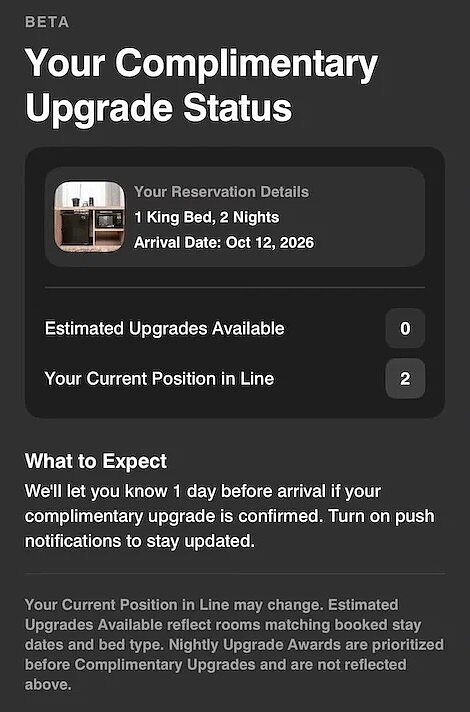
The first sighting came from a Titanium member who saw the page appear during mobile check-in, two days before arrival. The layout has three parts:
- Estimated Upgrades Available. In this case, the number was zero.
- Your Current Position in Line. The member was second, then dropped to third.
- A notification line. Marriott says it will tell you one day before arrival whether your complimentary upgrade is confirmed, and recommends turning on push notifications.
The fine print adds three rules. Your position in line may change. The estimated upgrades count only rooms that match your booked dates and bed type. Nightly Upgrade Awards are processed ahead of complimentary upgrades and are not included in the number shown.
One useful detail: the member held reservations at two hotels while finalizing plans. The waitlist appeared for a SpringHill Suites booking but not for a Marriott-branded hotel. That points to a hotel-by-hotel test rather than an account-level one.
Why a Position Can Slip From Second to Third
The ranking is not static, and it is not new. Hotels have for some time received an ordered list of arriving guests, each with an internal score suggesting whom to upgrade first. The formula has never been published, including how ties between members of the same tier are broken.
In July 2025, Marriott added automated complimentary upgrades. The system can assign upgrades before arrival, cutting work for front desk staff. Hotels still decide which room categories go into the upgrade pool and still control final room assignments.
Reports from hotel employees fill in some gaps. One described the automated system assigning a two-bedroom suite to a Gold member for five nights, ahead of Platinum and Titanium members arriving the same day. Another had seen lower-tier members receive higher internal scores. A third explained that after Nightly Upgrade Awards are processed, only 50% of the remaining eligible inventory goes to automated complimentary upgrades, with the rest left to the hotel. At that employee’s 171-room property, exactly one room qualified.
So a drop from second to third could mean a higher-scoring member booked the same dates, someone applied a Nightly Upgrade Award and took a room out of the pool, or the hotel adjusted which room types participate. The app does not say which.
How Nightly Upgrade Awards Fit In
Nightly Upgrade Awards (NUAs) came out of the Starwood acquisition and were originally called Suite Night Awards. They run on a separate track from complimentary upgrades and take priority over them.
The processing schedule is fixed:
- At most brands, the system starts trying to confirm five days before arrival.
- At EDITION, Ritz-Carlton, and St. Regis, it starts three days out.
- Around 2 p.m. hotel time the day before arrival, unsuccessful requests stop being checked and are closed.
NUA inventory is drawn from rooms the hotel does not expect to sell, either through booking channels or front desk upsells. The hotel chooses which room types participate; Marriott then decides how much of that inventory to release based on its sales forecast. That is why a junior suite can sit for sale across your entire stay while your NUA never clears. The two are not contradictory.
A rejected NUA does not rule out a complimentary upgrade. The hotel can still make a different call when it pre-blocks rooms or when you check in. But within the new waitlist, NUAs consume upgrade rooms first, and only what is left feeds the “Estimated Upgrades Available” figure.
The Upgrade Promise Changed in May 2025
Reading the waitlist correctly requires knowing what the upgrade benefit now says. Until May 2025, Platinum members and above were promised the “best available room, including suites.” The current terms say suites are among the possible upgrades, subject to availability on arrival for the full stay, but there is no longer a promise of the best available option.
A hotel that moves you from a standard room to a high floor while leaving a suite unsold is fully within the rules. The waitlist does not distinguish between these outcomes. Being second in line could mean second in line for a high-floor room or for a suite; the screen gives no indication.
Housekeeping is a related issue. A larger room costs more to clean, and the guest pays the same rate either way, so upgrading raises the hotel’s cost. Some properties leave suites uncleaned until someone pays for one. Others delay marking a cleaned suite as inspected and ready, which keeps it out of the assignable pool.

“Confirmed One Day Before Arrival” vs. How Hotels Actually Work
The app promises an answer one day before arrival. In practice, well-run hotels tend to process upgrades during the overnight shift or on the morning of arrival, once they know exactly who is coming and what rooms are open. Many upgrades are also decided at the front desk during check-in.
A “not confirmed” message the day before arrival therefore means the automated pass did not assign you a room. It does not mean the stay is settled. The hotel can still upgrade you manually later.
From my own stays, I would add that a hotel’s preferences do not always line up with corporate’s ranking. Properties often favor guests who return regularly, even over a first-time Titanium member with a higher tier. None of that shows up in the app’s position number.
What You Can Do With This Information
The screen is limited, but it does support a few concrete actions.
Complete mobile check-in two days out. The waitlist has only appeared inside the mobile check-in flow. If your booking is part of the test, you will not see it otherwise.
Turn on push notifications for the Marriott app. Confirmation comes by push. With notifications off, you will have to keep reopening the page.
Book the bed type that matches the hotel’s upgrade rooms. Estimated upgrades count only rooms with your booked bed type. If you book two doubles and the hotel’s suites are mostly king, the number available to you shrinks. When bed type does not matter to you, book the configuration most common in the hotel’s suites, usually a king.
Do not treat zero as final. That figure is what is left after NUAs, within the pool the hotel released, matching your dates and bed type. It excludes rooms the hotel keeps for its own discretion and rooms not yet cleaned. Asking politely at check-in still has value.
If you want a suite, use an NUA rather than waiting for a complimentary upgrade. NUAs are processed first and on a published schedule. For stays that matter, attach the award well before the five-day (or three-day) window opens so the system has the full period to try.
Read position and availability together. Second in line with three upgrades available is a reasonable expectation. Second in line with zero available depends on whether rooms are released the day before.
Where This Is Likely Heading
Airlines have run visible upgrade lists for years, and the next step there is well established: when you are far down the list or availability shows zero, a paid option appears to confirm the better seat and skip the line. Hotel groups, Marriott included, have been selling advance upgrades to elite members more aggressively. A waitlist that makes “you probably won’t get it” visible will naturally make a paid offer more attractive.
A second possible effect is tighter central control. If complimentary upgrades move toward being processed mainly by the automated system, the overnight team’s room to make judgment calls shrinks. Some guests will prefer the consistency; guests who rely on relationships at a favorite property may not.
For now this is a beta that most members cannot see. It offers more than the total opacity that came before, but without room-type detail or any view into the inventory behind the numbers, its practical value is modest. If the screen appears in your app, treat it as one data point: check in, use your NUAs, and still ask at the desk.














All Comments (0)