




Convert Marriott Points to Airline Miles
Marriott Bonvoy points offer utility beyond booking hotel rooms. Members have the option to convert their hotel points into airline miles across nearly 40 global frequent flyer programs. This cross-program flexibility is a notable feature of the Marriott ecosystem.
Converting points to miles requires an understanding of specific transfer ratios, bonus thresholds, and strict account matching rules. This article details the mechanics of the transfer process, highlights which airlines offer the best value, and provides practical strategies for managing your point balance.
When to Convert Points to Miles
The base transfer ratio for most airlines is 3:1, meaning three Marriott points equal one airline mile. Because of this ratio, transferring points results in a lower numerical balance. However, specific situations make this conversion highly practical and financially logical.
Converting points is useful when you have a small, leftover balance that is not enough for a free hotel night. Instead of letting a few thousand points sit idle, moving them to an airline program provides tangible value for a future flight.
Transfers are also effective for bridging a mileage gap. If you are close to booking an expensive international business or first-class ticket and lack a few thousand miles, transferring Marriott points is a reliable way to top off your account and secure the seat.
Furthermore, Marriott partners with several airlines that lack direct transfer relationships with major credit card programs like Chase Ultimate Rewards or American Express Membership Rewards. Programs like American Airlines AAdvantage, Japan Airlines (JAL) Mileage Bank, and Alaska Airlines Mileage Plan are harder to accumulate miles for through credit card spending. Marriott serves as one of the few stable transfer partners for these specific airlines.
From a valuation standpoint, Marriott points are generally worth between 0.7 and 0.9 cents each. To make a 3:1 transfer mathematically viable, the resulting airline mile needs to be redeemed for at least 2 cents. This value is most commonly achieved when booking long-haul premium cabin flights.

Essential Transfer Rules
Before initiating a transfer, you must account for the structural rules of the Marriott system. These factors dictate how and when you can use your newly acquired miles.
Processing Times and Reversibility
Point transfers are not instantaneous. In most cases, it takes up to seven business days for the miles to reflect in your airline frequent flyer account. If you are targeting a specific award seat with low inventory, this delay poses a risk. A practical workaround is to call the airline and ask if they allow you to place the award ticket on hold while you wait for the transfer to clear.
Additionally, the conversion process is strictly one-way. Once Marriott deducts the points and sends them to the airline, the transaction cannot be reversed. You cannot move the miles back to your Marriott account if you change your mind or if the award ticket you wanted becomes unavailable.
Once the miles are successfully deposited, they are subject entirely to the expiration policies and redemption rules of the receiving airline.
The Exact Name Match Requirement
The most common reason for a failed transfer is mismatched account information. Official rules dictate that your first and last name on your Marriott Bonvoy account must exactly match the first and last name on your airline frequent flyer account.
Automated systems compare these profiles closely. If the first and last names do not align perfectly, the system will trigger an error. A rejected transfer can leave your points in a pending status for weeks, and Marriott may temporarily restrict your account if they suspect unauthorized activity.
Log into both your Marriott and airline profiles to verify your personal information before starting the transfer. Update any discrepancies first to ensure a smooth transaction.

Transfer Ratios and the 60,000-Point Bonus
Marriott supports transfers to a wide variety of airlines. While the base ratio is standard, Marriott applies a volume bonus that changes the math significantly for larger transfers.
When you transfer exactly 60,000 points in a single transaction to a standard partner airline, the base 3:1 ratio first converts them into 20,000 airline miles. Marriott then adds a 5,000-mile bonus to that transaction. Therefore, a single transfer of 60,000 Marriott points yields a total of 25,000 airline miles.
Airlines with Standard Ratios
The 3:1 ratio and the 60,000-point bonus apply to the majority of Marriott's partners. These include:
- Star Alliance: Air Canada, ANA, Air China, Singapore Airlines, Asiana, EVA Air, Turkish Airlines, THAI, TAP Air Portugal, Copa Airlines, Aegean.
- Oneworld: British Airways, Cathay Pacific, JAL, Alaska Airlines, Qantas, Qatar Airways, Iberia, Finnair.
- SkyTeam: Air France-KLM, Aeromexico, Saudia.
- Non-Alliance: Emirates, Etihad, Virgin Atlantic, Virgin Australia, China Southern, Hainan Airlines, Southwest, Hawaiian, Frontier, Aer Lingus, LATAM, Vueling.
Exceptions and Special Ratios
A few airlines deviate from the standard transfer rules. Pay close attention to these exceptions to avoid miscalculating your expected mileage.
- United Airlines (MileagePlus): United offers the best transfer value due to the RewardsPlus partnership. You get a 10,000-mile bonus for every 60,000 points transferred. Transferring 60,000 points yields 30,000 United miles (a highly efficient 2:1 effective ratio).
- American Airlines, Delta Air Lines, and Avianca: These programs operate on the base 3:1 ratio but do not participate in the 60,000-point bonus. Transferring 60,000 points yields exactly 20,000 miles.
- Air New Zealand (Airpoints): The transfer ratio is 200:1. Transferring 60,000 points yields just 375 Airpoints.

Recommended Airline Partners for Maximum Value
Because airline loyalty currencies differ substantially in how they price award seats, identical transfer ratios can produce vastly different financial returns. The following programs generally offer the best potential for high-value redemptions:
- United Airlines MileagePlus: Thanks to the RewardsPlus partnership, transfers to United provide an exceptional 2:1 ratio when transferring in 60,000-point blocks (delivering 30,000 miles). This represents the highest conversion return in the Marriott program, making it an efficient way to book flights across the global Star Alliance network.
- Alaska Airlines Mileage Plan: Alaska miles are among the hardest to acquire because the program does not partner with major credit card transferable currencies like Chase or Amex. Redeeming Alaska miles for long-haul partner flights—such as Cathay Pacific business class to Asia or Qantas flights to Australia—often yields redemption values well above 2 cents per mile.
- Turkish Airlines Miles&Smiles: Turkish Airlines features uniquely favorable award charts for domestic flights within the United States on Star Alliance partner United. Booking United flights from the US mainland to Hawaii using Turkish miles frequently requires far fewer miles than booking directly through domestic carriers.
- Air France-KLM Flying Blue: Flying Blue regularly releases “Promo Rewards,” discounting transatlantic award tickets by up to 25%. Using a small Marriott transfer to cover the remaining miles needed for a discounted business class ticket across the Atlantic can extract significant value from your points.
How to Execute the Transfer
Once your accounts are prepared, the actual transfer process is straightforward.
1. Log into the Marriott Bonvoy website and navigate to the Points to Miles transfer page.

2. Select your target airline from the dropdown menu and input your frequent flyer number.
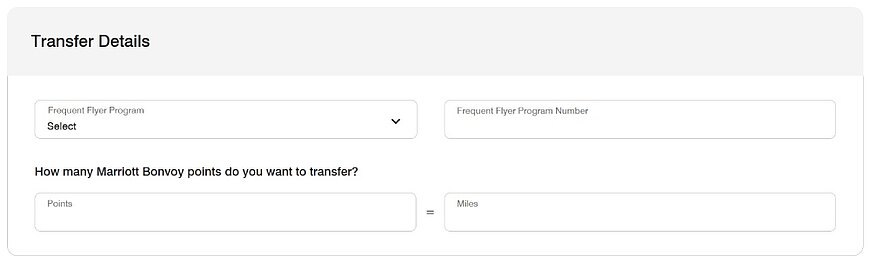
3. Enter the number of points you wish to convert. You can transfer anywhere from a minimum of 3,000 points up to a maximum of 240,000 points per day.
4. Review the details and submit the request.
Strategies to Reach the 60,000-Point Threshold
To benefit from the bonus miles, you must transfer 60,000 points in a single transaction. Making multiple smaller transfers that add up to 60,000 will not trigger the bonus.
If you are short of the 60,000-point mark, you can utilize Marriott's point transfer feature between members. You can transfer up to 100,000 points out of your account and receive up to 500,000 points per calendar year. Pooling points with a family member or friend is the most efficient way to hit the bonus threshold without spending money.

Another option is buying Marriott points directly, though this requires careful math. The standard limit allows you to purchase up to 150,000 points per calendar year (though Marriott occasionally runs promotions that temporarily increase this limit).
Marriott typically sells points for 1.25 cents each, or roughly 0.86 cents during promotional sales. Even at the promotional rate, buying enough points to reach 60,000 costs over $500. This equates to buying airline miles at roughly 2 cents each. This strategy is only advisable if you are a few thousand points short of the threshold and are booking a specific, high-value premium cabin ticket. Do not buy large amounts of points speculatively just to convert them to miles.

Using Transfers to Prevent Point Expiration
Marriott points expire if an account has no qualifying activity for 24 consecutive months. Converting points to airline miles counts as qualifying activity.
If your points are nearing expiration and you have no upcoming hotel stays, transferring the minimum requirement of 3,000 points to an airline is a simple solution. This generates a small amount of usable airline miles and immediately resets the 24-month expiration clock for the remaining points in your Marriott account.
Earning Preference: Points vs Miles
Marriott allows you to adjust your account settings to earn airline miles automatically instead of hotel points for your stays. However, selecting this option restricts your earning potential.
If you set your preference to miles, you will not receive the elite member bonus points on your hotel folios. Additionally, elite welcome amenities chosen as points will still deposit into your account as Marriott points, requiring manual conversion later. Furthermore, miles earned automatically are sent directly to the airline, locking you into that specific program and removing the flexibility of choosing different partners later.
Keep your earning preference set to Marriott Bonvoy points. This ensures you maximize your elite earning bonuses and maintain full control over when and where you transfer your balance.
Summary
Converting Marriott points to airline miles is a practical tool for securing award flights, especially with airlines that lack direct credit card transfer partners. By understanding the 3:1 base ratio, taking advantage of the 60,000-point bonus, adhering to the 240,000-point daily transfer limit, and ensuring your first and last account names match perfectly, you can extract maximum value from your hotel point balance. Always plan ahead for transfer delays and only execute the conversion when you have a clear, high-value redemption in mind.















All Comments (0)