


Buy United MileagePlus Miles
United MileagePlus is running another buy miles promotion from 8:00 a.m. CT on October 21, 2026, through 11:59 p.m. CT on October 31, 2026. The offer is targeted, so the bonus you see depends on your account. The best version is a 100% bonus, which brings the cost down to 1.88 cents per mile. Other members are seeing 95% or 80%.
The 50,000-mile cap per 90 days that United introduced earlier this year still applies. This article covers the bonus tiers, the purchase limits, what the miles actually cost, how the offer compares with the past year of sales, and the situations where buying makes sense versus paying cash for the ticket.
Bonus Tiers and Pricing
Log in to your MileagePlus account and open the buy miles page to see which version of the offer you have. Bonuses are calculated per transaction only, and separate transactions cannot be combined to reach a higher tier. To get the top bonus, you need to buy enough miles in a single purchase.
The 100% bonus version is structured as follows:
- 2,000–4,000 miles: no bonus
- 5,000–19,000 miles: 75% bonus
- 20,000–25,000 miles: 100% bonus
The 95% version has the same 75% middle tier, with 95% applied only to purchases of 20,000 to 25,000 miles. Some accounts only show an 80% top tier. The minimum purchase is 2,000 miles, and you can buy in increments of 1,000 miles.
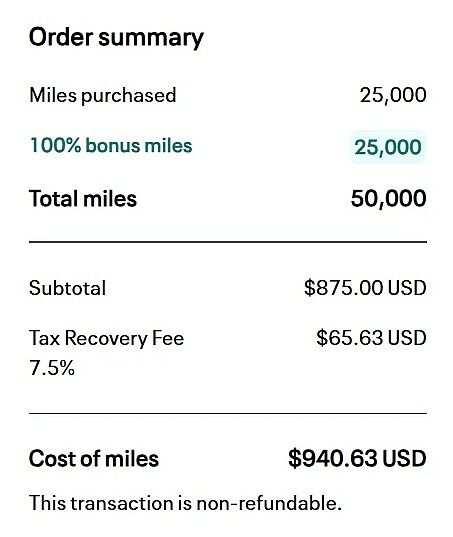
United’s base price is 3.5 cents per mile, plus a 7.5% federal excise tax, for an all-in cost of 3.76 cents. Here is what each bonus level works out to:
| Bonus | Cost per mile (incl. tax) | Miles received for a 25,000-mile purchase | Total cost |
|---|---|---|---|
| 100% | 1.88 cents | 50,000 | $940.63 |
| 95% | 1.93 cents | 48,750 | $940.63 |
| 90% | 1.98 cents | 47,500 | $940.63 |
| 80% | 2.09 cents | 45,000 | $940.63 |
| 75% | 2.15 cents | 43,750 | $940.63 |
The dollar amount is the same regardless of the bonus. What changes is how many miles you get. If your account shows a lower bonus, it is worth checking a spouse’s or family member’s account, since the offers vary from person to person.
Purchase Limits: 50,000 Miles per 90 Days, 200,000 per Year
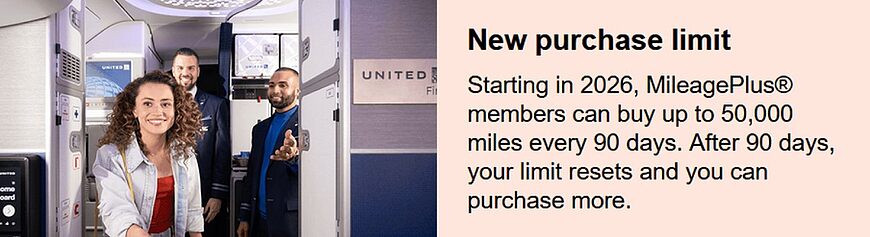
This is the biggest change to United’s buy miles program in 2026. The per-transaction limit used to be 200,000 miles. The current rules are:
- Miles bought, gifted, or multiplied within any rolling 90-day period cannot exceed 50,000, and bonus miles count toward that number.
- Each account is limited to 200,000 miles per calendar year, again including bonus miles.
- The 90-day window is calculated from the date of each transaction. Your eligibility to buy more resets only after 90 days have passed.
Under the 100% bonus, buying 25,000 miles and receiving 25,000 bonus miles uses the full 50,000-mile allowance in one go. If you maxed out the September promotion (September 8–30), your allowance will not reset during this sale. The earliest you could buy again is 90 days after that September transaction.
A few other terms to be aware of:
- Miles usually post immediately, but some transactions can take up to 72 hours.
- Purchased miles are nonrefundable.
- Purchased miles do not count toward Premier status.
- Canadian residents are charged GST/HST, and Quebec residents are also charged QST.
- Promotional pricing is only available through buymiles.mileageplus.com.
Is 1.88 Cents a Good Price?
Not particularly, in the context of United’s recent sales. As the next section shows, United has run a sale almost every month over the past year, and the top tier has been a 100% bonus or 50% discount nearly every time, which is the same 1.88 cents per mile. This is the standard sale price now, not a special one. The only time United miles have been cheaper was in 2020, when the excise tax was waived and miles sold for 1.75 cents.
Most independent valuations put United miles at roughly 1.2 to 1.3 cents each. Paying 1.88 cents means you need a redemption that returns well above the average. As a rule of thumb, short-haul economy awards return around 1.3 to 1.4 cents per mile, long-haul economy about 1.7 cents, and only long-haul business or first class gets above 3 cents. In practice, this sale is only useful for long-haul premium cabin awards.
United Buy Miles History
The table below lists the promotions between October 2025 and October 2026. The bonus shown is the best version known for each sale; what any individual account displayed may have been lower.
| Start date | End date | Top bonus | Cost per mile (incl. tax) |
|---|---|---|---|
| October 21, 2026 | October 31, 2026 | 100% | 1.88 cents |
| September 8, 2026 | September 30, 2026 | 100% | 1.88 cents |
| July 14, 2026 | August 20, 2026 | 100% bonus or 50% discount | 1.88 cents |
| May 13, 2026 | June 24, 2026 | 100% | 1.88 cents |
| April 8, 2026 | April 30, 2026 | 100% bonus or 50% discount | 1.88 cents |
| February 12, 2026 | March 31, 2026 | 100% | 1.88 cents |
| January 8, 2026 | January 26, 2026 | 100% | 1.88 cents |
| October 1, 2025 | October 18, 2025 | 95% | 1.93 cents |
Roughly 12 sales in 12 months, with gaps between them usually lasting one to three weeks. What this means in practice: missing this sale is not a problem, since the next one will almost certainly show up within a few weeks. On the other hand, if you intend to buy the full 200,000 miles in a year, you need to plan four purchase windows, each during a promotion and each at least 90 days after the previous transaction.
When Buying United Miles Makes Sense
The best case is straightforward: you have found award space on a long-haul business class flight, you are short on miles, and the cost of topping up is less than the cash fare.
United dropped its award charts in 2020 and uses dynamic pricing on its own flights, but partner awards still price at fairly predictable levels. The most common example is a one-way business class award between the U.S. and Europe. United Polaris starts at 80,000 miles for United cardholders or 88,000 for non-cardholders, and partner business class on Lufthansa and others generally sits around 80,000 miles as well.
Using the 80,000-mile price:
- Buying the maximum 50,000 miles at the 100% bonus costs $940.63.
- The remaining 30,000 miles at the standard 3.76 cents would cost $1,128, for a total of about $2,069.
- Cash fares for a one-way business class seat on these routes are typically over $3,000.
If you already have 30,000 miles in your account, the top-up costs just $940.63. Even buying every mile comes in below the cash fare, though the margin is smaller. One-way tickets are where the gap is widest, since one-way business class fares are often more than half the round-trip price.
Another option is MileagePlus pooling. United allows family members to combine miles into one account for redemptions, so two people can each buy 50,000 miles and then pool them, which gets the entire award at the 1.88-cent rate. Keep in mind that pooled miles can only be used for flights on United, United Express, and partner airlines, not for upgrades.
When You Should Pay Cash Instead
Domestic and short-haul awards almost never justify the purchase. A one-way transcontinental first class award can price around 70,000 miles while the cash fare is roughly $700, which is about 1 cent per mile. In that situation, paying cash is the better choice even with a zero balance.
Money + Miles gives a fixed 1 cent per mile, so it is a poor use of purchased miles. The same goes for United Club memberships, car rentals, hotel stays, merchandise, and gift cards, all of which return far less than the purchase price.
One more factor: primary United cardholders get award pricing that requires at least 10% fewer miles on United-operated flights, and cardholders with Premier status get at least 15% fewer. This does not apply to partner awards. If your target is a United-operated long-haul business class seat, being a cardholder reduces the number of miles you need and therefore the amount you would spend.
How to Buy and Which Card to Use
The process is simple: log in, go to the buy miles page, choose the quantity, and pay. The card is billed immediately and purchases are nonrefundable, so confirm award availability before you buy.
Which card you pay with matters:
- A United cobranded card: under the promotion terms, the purchase counts as a United purchase, so you earn the miles you buy plus miles at your card’s United purchase rate.
- Any other card: the transaction is processed by Points.com and appears as “Points United Miles” on your statement. It is not coded as airfare or travel, so use a card where you are working toward a minimum spend requirement, or whichever card earns the most on everyday purchases.
Other Ways to Get United Miles
If you are not in a hurry, buying is rarely the cheapest route. MileagePlus miles never expire, so there is no pressure to use them quickly. Alternatives include:
- Chase Ultimate Rewards points transfer to MileagePlus at 1:1, usually instantly. Bilt Rewards points also transfer at 1:1.
- Marriott Bonvoy points transfer at 3:1, with a 10,000-mile bonus for every 60,000 points moved in one transaction. That makes 60,000 Bonvoy points worth 30,000 United miles, the best ratio among hotel programs, though you should still weigh the value of the Bonvoy points themselves.
- World of Hyatt (1,250:500), Hilton Honors (10,000:1,000), and IHG One Rewards (10,000:2,000) also transfer, but the ratios are poor and generally not worth it.
- United’s cobranded cards currently offer welcome bonuses between 80,000 and 100,000 miles, which is more than you can buy in this entire promotion.
Bottom Line
The 100% bonus brings the cost to 1.88 cents per mile, but that is roughly the tenth time in the past year United has offered the same price. The real constraint is the 50,000-mile cap per 90 days, which is not enough to buy a long-haul business class award on its own.
The practical approach is to find award space first, work out how many miles you are short, and confirm the purchase costs less than the cash fare. If the gap is small, or if you can pool miles across family accounts, this sale can work. If you simply want to stockpile miles or have a short-haul trip in mind, paying cash will almost always come out ahead.






All Comments (0)